Big Data is large amounts of gather information. These data sets are used by organizations to benefit their company. The three V’s of Big Data are Volume, Variety and Volume. Big Data is useful for businesses to help them reach their targeted audience and market towards specific groups. Also, big data helps personalize ads and track social media campaigns. Social media is a growing platform and data shows that people are becoming addicted to it. In the future, there will be more social media networks created that will be able to be tracked and used. Social media will influence the world by creating occupations, becoming part of business strategies, changing public health, and helping change world challenges. I predict in the future, businesses will become reliant on social media and big data. Also, there will be more social media accounts being created which will allow businesses to gather even more data. Overall, big data has changed the approach of businesses and social media will continue to grow and expand.
Author: marlicaplan1314
Kayla Itsines
Introduction
Kayla Itsines is a personal trainer, author and entrepreneur from Adellaide, Australia. Ever since she was a kid, she has always been interested in health and fitness. She played basketball as a child but truly fell in love with working out and loved how it made her feel. By the age of 18, she became a master trainer in fitness. Her main accomplishments are creating an ebook called ‘Bikini Body Guides’, creating a meal-plan, and developing an app called Sweat. Her main goal is to educate and support women with their health and fitness journeys.
Career
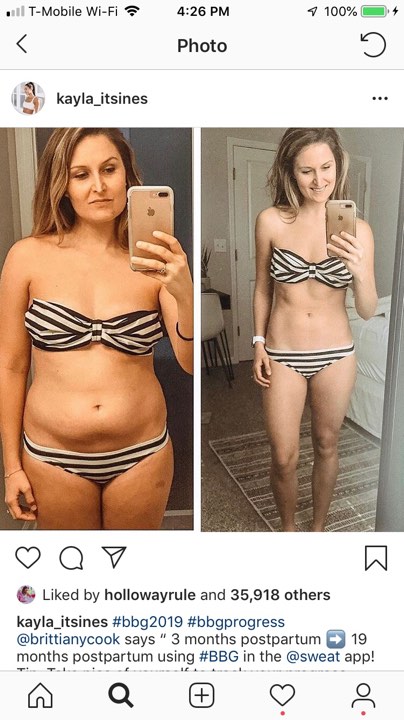
Right after graduating from high school, Kayla studied at the Australian Institute of Fitness and became a personal trainer. Kayla began her fitness career by helping her sister and her friends train for netball. They gave her the idea to take before and after photos to post on social media. She began to use Instagram as a way to organize her photos. Her account quickly got popular and she was getting many requests from followers for workout and nutrition advice. Her fiancé, Tobi Pearce, gave her the idea to put her workout routines into an eBook. Together, Tobi Pierce and Kayla Itsines created the Bikini Body Training company in 2013 of March. Kayla is the director while Tobi is the CEO. They initially created two guides and had over one million downloads by October that same year. Kayla continued to post before and after photos of her clients on her Instagram. Exercise and diet have been trending on social media and people are looking for a support system. “Participants of many weight loss-driven studies have noted that it was the social support garnished by a support system that most greatly aided them in their successful weight loss endeavors, or the lack thereof that made them unsuccessful in their efforts” (Faw, 2014). Social support is essential for weight loss and this can be a very sensitive topic for most people. Kayla’s social media accounts are a way for individuals to embrace their fitness journey and have a support system.
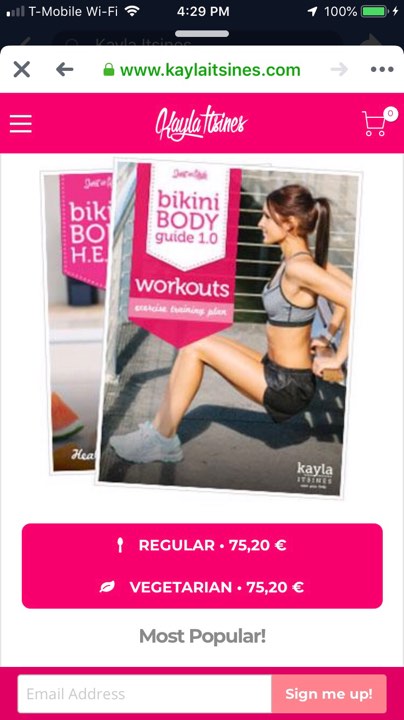
In 2015, Kayla and Tobi went on tour which they called ‘Kayla Itsines Bootcamp World Tour’. During this tour, Kayla would host group workout classes in large cities and they would sell out instantly. Also in 2015, Kayla created an app called ‘Sweat’. Initially, this app was criticized by customers who already spent money on the Bikini Body Guide. In response, Kayla gave all customers who purchased the eBook a discount of $1 for the first month’s use of the app. In 2017, Kayla published her second and most recent book titled ‘The Bikini Body Motivation & Habits Guide’. The price of the eBooks are $75.20 euros. A monthly membership for the app Sweat is $19.99 euros a week or $119.94 euros a year. These workouts are designed for anyone interested in working out; from beginners to experts. These workouts are designed to be completed either at the gym or at home. Within the app, there is a blog to discover new workouts and get nutritional information, a forum to share your fitness goals and support others, and a shop to purchase necessary items to help you train. Kayla’s fitness career has really taken off and she was titled one of the most influential people on the internet in 2016. In addition, her and Tobi were on the BRB Young Rich list in 2016.
Social Media
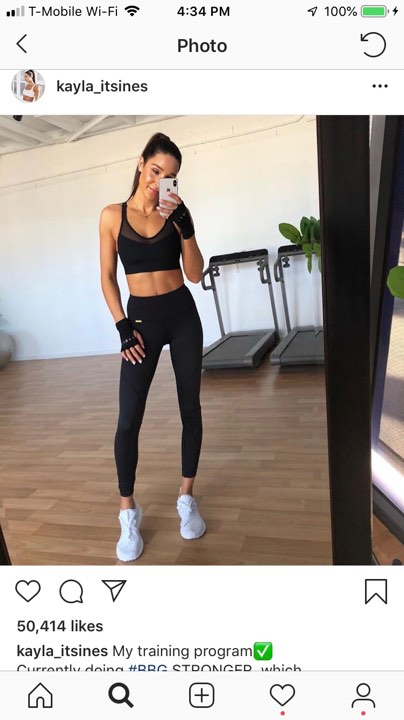
Facebook and Instagram are important platforms used by Kayla Itsines. In 2016, she had 8 million followers on Facebook and 5 million followers on Instagram. Today, she has 25 million followers on Facebook and 11.2 million followers on Instagram. Kayla focuses on her followers and their needs on her social media accounts. On her Instagram, she posts photos of her workout routines, before / after pictures of her clients, food pictures, and inspirational quotes. She doesn’t post up-close pictures of her face and rarely posts personal photos. Kayla doesn’t promote every brand that is offered to her, she is very particular with what she promotes and makes sure she believes in what she promotes. According to an article by Elmira Djafarova and Chloe Rushworth, “The research findings show that celebrities on Instagram are influential in the purchase behavior of young female users”. It is also more common for non-traditional celebrities (Instagram influencers) to impact the purchases of followers compared to mainstream celebrities (movie stars) because they are more relatable and credible. This can explain why Kayla Itsines’ eBooks and app are so popular among the public. People can relate to her and can strive to get more fit and healthy.
Identity
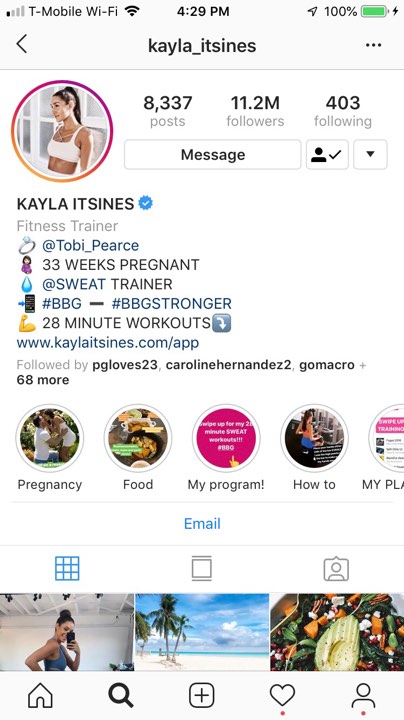
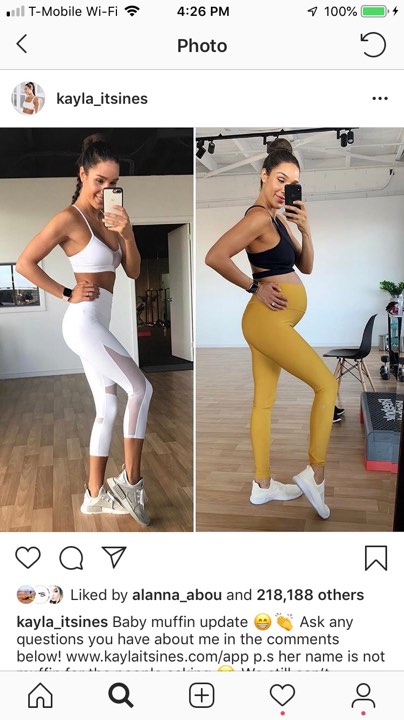
There are many aspects to Kayla that create her identity on social media. First, her fiance Tobi Pearce is part of her identity. He is also a personal trainer and is the CEO of Sweat. Their social media platforms coincide and they post numerous pictures together. In addition, Kayla came public in December of 2018 on Instagram that her and Tobi are expecting their first child in May of 2019. This has become part of her new identity on social media. Although, this hasn’t stopped her from exercising and posting fitness videos of herself. Being pregnant has created a whole new demographic of people who would be interested in following her. Pregnant women around the world can learn how to remain fit and healthy while being pregnant if they follow Kayla’s social media. Another part of her identity is that she is Greek and comes from a strong rooted family. Her heritage is incorporated into a variety of the foods she recommends and posts on her Instagram. All of these elements help creates Kayla’s identity that she portrays on social media.
Conclusion
Health and fitness are very important to me and have always been something I strive to excel in. Following Kayla’s Instagram account has taught me new workouts and ways to incorporate fitness into my everyday life. I have tried a bunch of her short workouts but have not yet purchase the Sweat app. I truly appreciate everything that Kayla posts and she definitely has an influence on my life. She has become not only a fitness influencer but also a life influence and someone people admire. Researching her story has helped me appreciate her even more and I plan on purchasing her eBooks and app in the near future.
Sources
Djafarova, Elmira, and Chloe Rush worth. “Exploring the Credibility of Online Celebrities’ Instagram Profiles in Influencing the Purchase Decisions of Young Female Users.” Science Direct. https://www.sciencedirect.com/science/article/pii/S0747563216307506.
Stark, Hiliary, Abdulrahman Habib, and Duha Al Smadi. “Network Engagement Behaviors of Ree Online Diet and Exercise Programs.” The University of Akron, December 2016. https://ideaexchange.uakron.edu/cgi/viewcontent.cgi?referer=https://scholar.google.es/&httpsredir=1&article=1061&context=docam.
Keogh, Joey. “The Untold Truth of Kayla Itsines.” The List. https://www.thelist.com/128410/the-untold-truth-of-kayla-itsines/.
“About Kayla Itsines.” Kayla Itsines. https://www.kaylaitsines.com.
“Kayla Itsines.” Wikipedia. https://en.wikipedia.org/wiki/Kayla_Itsines.
Camp Saginaw Wikipedia Page
I was given the vague task by my professor to simply create a Wikipedia entry on a topic I am interested in and know a lot about. Initially, this seemed rather easy to me. The topic I decided to write about was the camp I attended for 12 summer, Camp Saginaw. One of the requirements was to choose a topic that currently didn’t have a Wikipedia page and Camp Saginaw satisfied this requirement. This camp is very important to me and I was initially excited to create this Wikipedia page.
After I wrote my entry in Microsoft Word about Camp Saginaw, it was time to physically make the Wikipedia page. I quickly went from being excited about an assignment to being very lost and confused. My professor gave us a few helpful links to use in order to create the page so I started there. I read through the links and was still lost as of what to do. I got really frustrated and had to give myself time away from trying to create this page.
Once I read the helpful links over with a clear mind, I knew that I needed to practice posting on Wikipedia with Sandbox. This website allows you to experiment with editing your entry and learn the ins and outs of Wikipedia. Sandbox clearly showed me how to create citations and hyperlink words. It gave simple tutorials on the buttons on the top of the editing page.
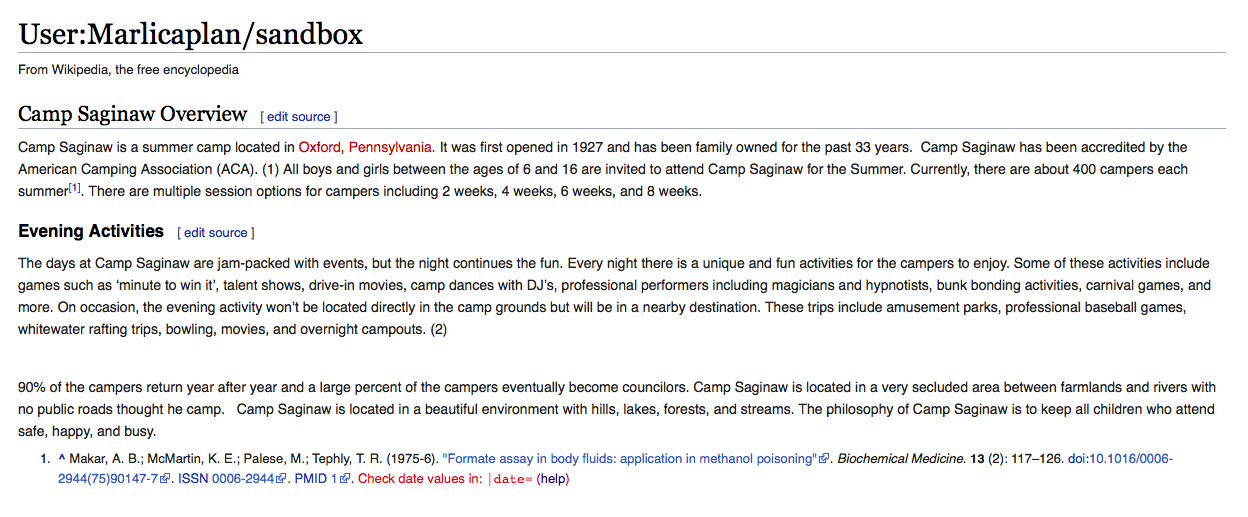
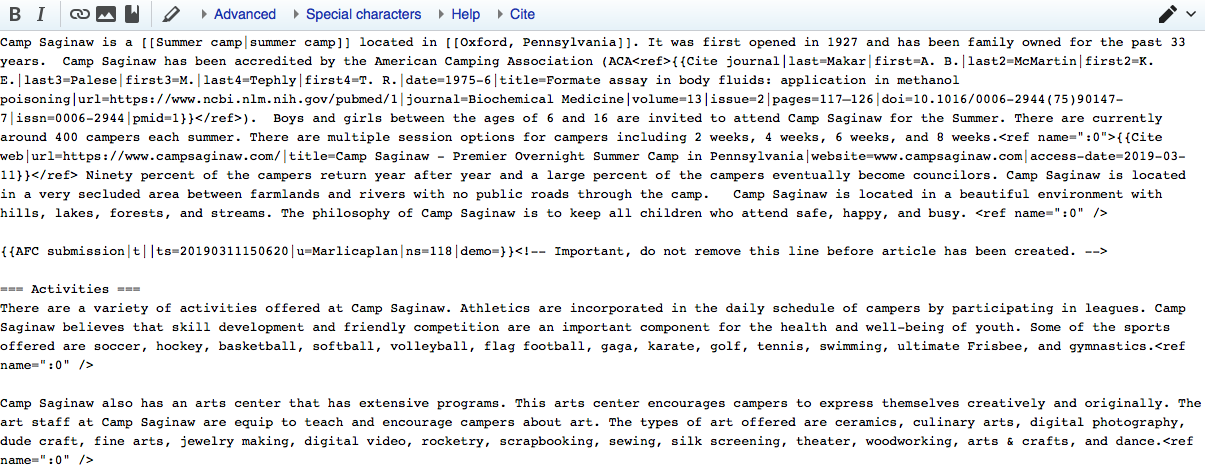
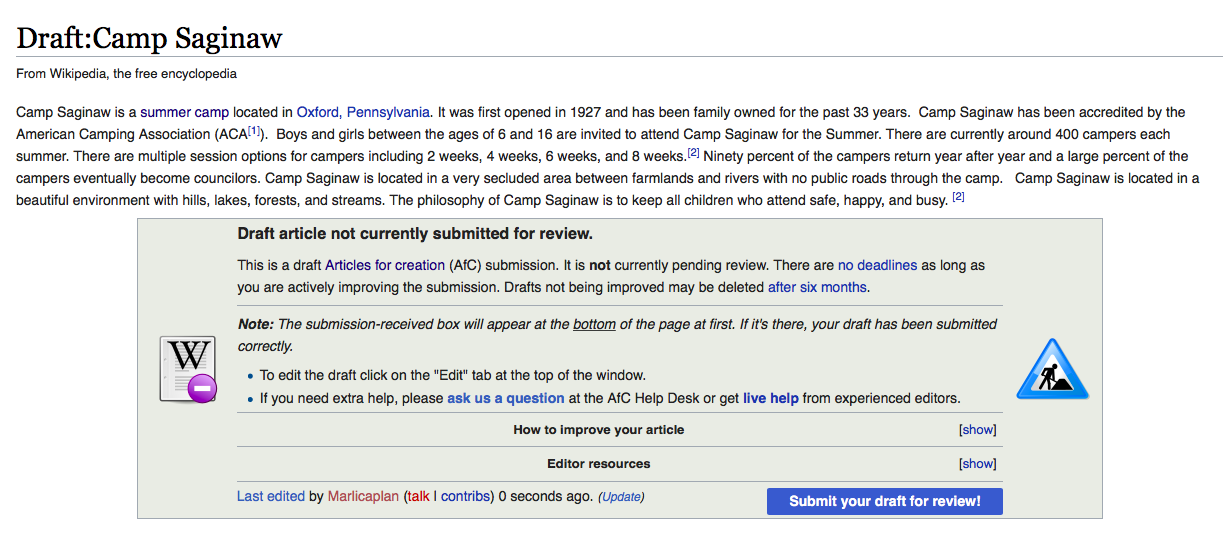
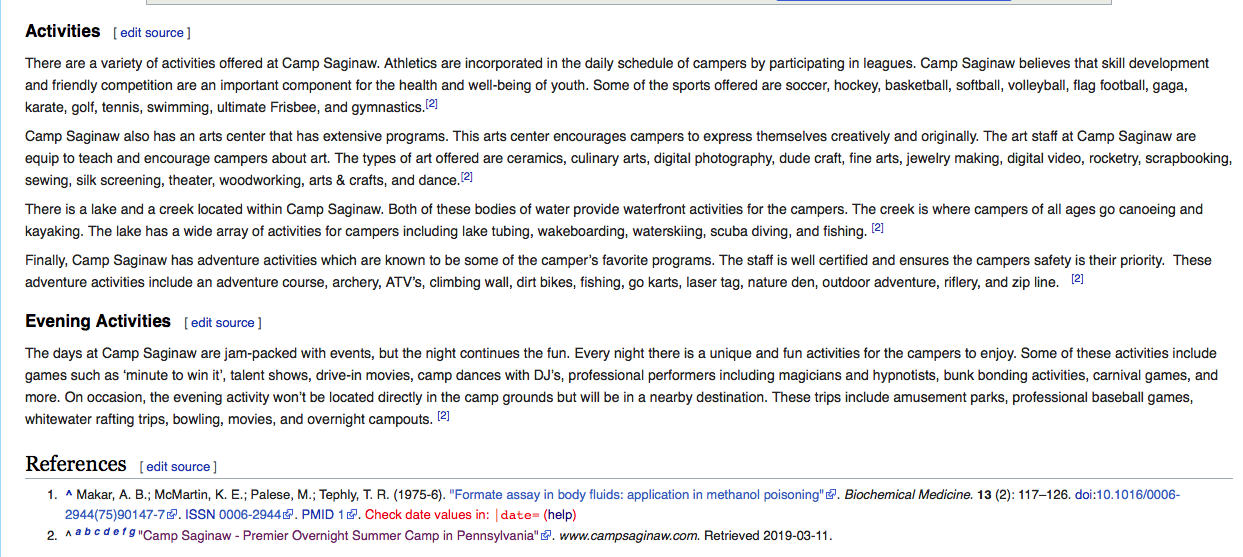
One of the sites provided by my professor was titled ‘Wikipedia, first time article.’ This site clearly spelled out which steps to take and how to go about actually making my Wikipedia page. First, this site helped me check to ensure that Camp Saginaw isn’t a previously made Wikipedia page. Also, this page led me to Article Wizard which creates a template on Wikipedia and puts your entry in draft space. Article Wizard makes you disclose your relationship to the information and ensure the text is original. Once I finished pasting my article in Article Wizard, I made citations and hyperlinked the words ‘summer camp’ and ‘Oxford, Pennsylvania’. Within Article Wizard, there was an option to change the format of the draft from source editing to visual editing. Once I clicked this, it completely changed my format and I got worried it would be deleted. To avoid this, I tried to go back but that action ended up deleting the article instead. I had to start over but it wasn’t difficult because I had already created a draft once before and used sandbox. During my second time creating the draft, I learned that switching to visual editing allows you to preview the article and this allowed me to export the page as a pdf.
Creating this Wikipedia page was not as easy as I initially expected it to be. Now that I have created one, creating another one wouldn’t be nearly as challenging. I came across several problems such as not knowing how to begin the process, deleting my page, and becoming very frustrated with the process. Looking back on this process, I should have done more initial research and watched a video tutorial on YouTube. I just jumped in and tried to create the page with the minimal information I had. Creating this Wikipedia page was a very different experience then I expected but now feel confident to make another one in the future.
The ‘Salt Bae’ Meme
Introduction
The meme I decided to analyze further was a meme I have seen on several different platforms with different wordings. This meme is known across the world as ‘salt bae’. This meme originated as a video which was posted to the Instagram of Turkish chef, Nusret Gökçe. In the video, he is cutting a massive steak and salting it by having the salt grains run down his arm. He is wearing dark glasses and a white shirt. This video is 36 seconds long and was posted on January 7th, 2017. Within 24 hours of Gökçe posting this video, it was screenshotted and spread all over social media in the form of memes. It is unknown who was the originator of the first meme, but it had the comical caption of “You vs. The Guy She Told You Not To Worry About”. In addition, it is unclear who named Gökçe as ‘Salt Bae’, but this hashtag quickly spread. After 48 hours of Gökçe posting the video, there were 2.4 million views. This tweet had celebrities, such as Bruno Mars, re-posting it within five days. Everyone was creating their own captions to the picture that was screenshotted from the video. It is clear that this video posted by Gökçe quickly caught the public’s attention and generated interest.

The First Meme
Memes began due to a misinterpretation of humor amongst colleagues in 1982. Issues would arise in this specific workplace because people thought their coworkers were being rude and aggressive online, but were actually trying to be funny. Scott E. Fahlman proposed to add a specific symbol (:)) to signify that the text was a joke. This symbol was called an emoticon. “Emoticons are a meme that serve a number of functions in the transmission of information. They can be used to frame content as positive or negative, serious or joking, or any number of other things”. (Michael Mandiberg) The use of these emoticons spread quickly and grew in meaning. Later, emoticons slowly transformed into captioning digital pictures which is known today as memes.
Types of Memes
Memes can be interpreted in a variety of ways, but all memes exist in layers. “Internet memes follow the same structure. One very common, rather large meme is the image macro. An image macro is a set of stylistic rules for adding text to images.” (Michael Mandiberg) Image macros have two main forms. One type is adding the same text to different images, similar to the example above “You vs. The Guy She Told You Not To Worry About”. This is a common meme text that can be placed on a variety of different images. Another form of memes is where you add different text to the picture. An example of this is captioning the ‘salt bae’ meme “Where am I going to find a man as salty as me.” This is specific towards the image itself and wouldn’t necessarily make sense on other images. This meme has many layers because it uses both of these forms of image macros.

Culture of Memes
I was interested to explore memes place in culture and its cultural motivation. An article written by Mary Midgley explains that the word meme comes from ‘mimeme’, which means a unit of limitation. “Richard Dawkins has suggested that the scientific approach to culture is to split it into units called memes, which are in some ways parallel to its atoms, in others to its genes, and to study their interactions.” Mary Midglet explains that culture cannot be labeled and have distinct units because it is continuously developing and affected by human behavior. Mary Midglet was initially confused how culture was affected by memes since culture isn’t in units. Although, mimeme were transmitted and spread from person to person by copying each other. This relates to internet memes and specifically to the ‘salt bae’ meme. Once Nusret Gökçe posted his video of Instagram, it spread all over the world and generated media attention. Therefore, culture is affected by memes due to spreading and transmitting visuals and information from person to person.
Conclusion
Memes aim to bring humor and laughter into the world. Although, there are several critics who raise questions against memes and Limon Shifman elaborates on three reasons in his article. He claims that memes can be offensive and don’t successfully interpret human behavior, memes give no added value to soceity, and that memes can create issues between agencies. Even though the ‘salt bae’ memes don’t have educational added value to society, I believe it is not offensive and it does interpret human behavior in a unique way. This meme is a fun and eye-catching picture that makes people think and interpret the picture in their own way. I think memes are away to connect with one another and bring light humor in our daily lives. I appreciate all that memes have to offer and think they are a great contribution to society and help develop our culture.
Citations
Davison, Patrick. “The Language of Internet Memes.” Edited by Michael Mandiberg. Social Media Reader. http://fall2015.veryinteractive.net/content/6-library/20-the-language-of-internet-memes/davison-thelanguageofinternetmemes.pdf.
Midgley, Mary. “Why Memes?” Alas Poor Darwin: Arguments Against Evolutionary Psychology. https://books.google.es/books?hl=es&lr=&id=HQthCC191y8C&oi=fnd&pg=PT117&dq=cultural motivations for memes&ots=3dGBcCGoJB&sig=iPlkfHuoa0cT1lupGmfFMyua120#v=onepage&q&f=false
Shifman, Limor. “Memes in a Digital World: Reconciling with a Conceptual Troublemaker.” Computer-Mediated Communication, March 26, 2013. https://onlinelibrary.wiley.com/doi/full/10.1111/jcc4.12013.
Feinn, Lilly. “How Did Salt Bae Start? The Origins of This Meme Are Pretty Tasty.” Bustel. January 18, 2017. https://www.bustle.com/p/how-did-salt-bae-start-the-origins-of-this-meme-are-pretty-tasty-31231.
Millennials
Intro
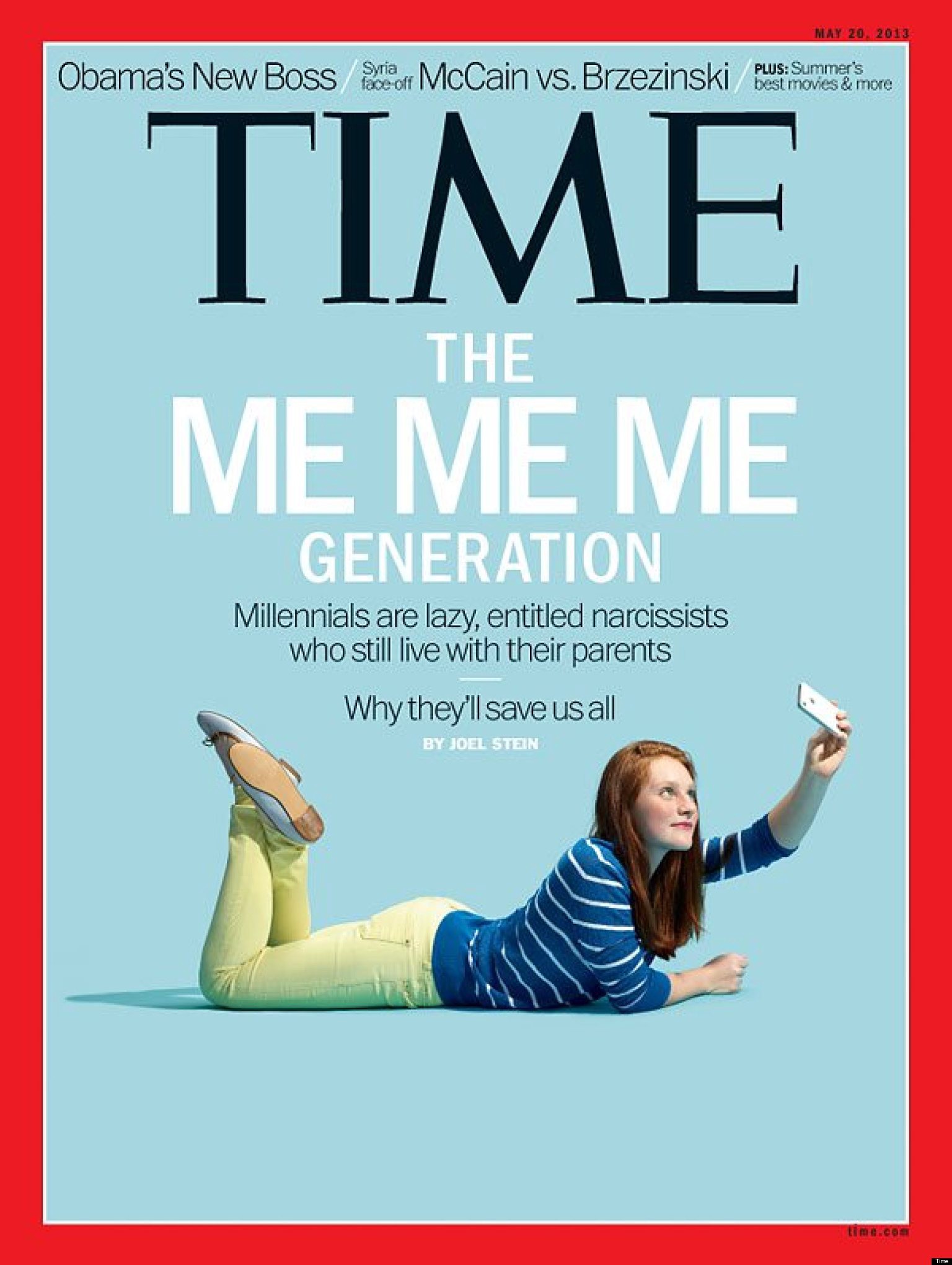
Technology and social media are major aspects of millennial life today. The term millennial refers to “the demographic cohort that would come of age in the year 2000, academics, consultants and institutions of all kids have carried out studied that they try to understand this cultural group” (Henry Jenkins). Overall, millennials are born between the early 1980 and 2000 and are children of baby boomers. They are known as being technologically savvy and digital natives. They are accustomed to the technological lifestyle because it is all they know. Although, there are negative connotations about millennials and their obsession with technology and social media. Members from other generations tend to generalize millennials and frown upon their social media use. Social medias impact is commonly discussed and studied to see its impact on millennials.
Social Medias Impact on Millennials
Social media has truly impacted millennials and their way of life. Statistics show that millennials are dependent on their phones and are the highest consumers of social media. “Social media apps like Facebook, twitter or snapchat, were originally used as a way to connect to one another and are now used as sites to broadcast our own lives, essentially making microblogs of our lives by documenting everything we say or do.” (Odyssey) Social media sites impact how millennials feel about themselves. A study from the Odyssey shows that primarily girls are affected from social media and it can be harmful to their mental health. Overall, social media can cause users to judge themselves and compare themselves to others. On the other hand, social media can positively impact millennials when looking for jobs and internships. Networking has completely changed with advanced technology. In order to communicate and build a relationship with a company, millennials have the option to use a variety of sites including LinkedIn, Facebook, Google, Twitter, email, etc. Being able to initially build online relationships and gather information about the company helps to improve future face-to-face encounter. For my upcoming internship this summer, I took advantage of several sites to finesse this internship position. I began by following the company on LinkedIn, then emailing the HR coordinator and showing my interest, then uploading my resume to their website, and finally having a facetime conversation with the manager. Without these variety of social media platforms, I may not have successfully received this internship offer. Social media advancements have increased the quality and value of networking, but cause self-esteem issues with millennials across the globe.
Stereotypes
There are many negative stereotypes about millennials and their overconsumption and obsession with social media. Some people believe that millennials are not community oriented, but are self-centered. Henry Jenkins has several concerns about this stereotype of millennials. First, he claims that it is impossible to generalize every millennial due to uneven access to the internet. In addition, he claims that adults learn from the youth about technology. Therefore, it is hard for them to make these observations due to not being technologically savvy and being born in a different generation. Overall, “It is too soon to make a lifelong generalization about who millennials are, what they value, what their personality type is, etc.” (Henry Jenkins) In addition, another common stereotype of millennials according to Dr. Roberts is that they are entitled, self-absorbed, and lazy. Dr. Roberts research concludes that it is impossible to compare youth today to the youth of baby boomers. The world has completely changed and so has the lifestyle and values. Therefore, these negative stereotypes about millennials today is a misconception and can’t be necessarily truthful.
The Participatory Culture
Henry Jenkins has studied the concept of participatory culture and has very valuable breakthroughs. He claims that students tend to learn more outside the classroom and use social media as a way to share what they do. Participatory culture uses social media as an outlet where everyone is invited to contribute. Everything and everyone becomes part of a participatory culture. “We’re seeing again and again these interest-driven networks are preparing the way for them to think of themselves as citizens in a new way, to mobilize the skills they developed as contributing to online communities and participatory culture and direct them toward changing society, changing the world.” (Henry Jenkins) Overall, these social media networks are platforms for people to engage and be part of a group. Jenkins believes that it is important for students to engage in these networks and for teachers to understand this concept of participatory culture and use technology within the classroom.
Conclusion
The internet is a part of our lives every day and effect the way we live. Millennials are primarily affected from social media and are the top user. The question of ‘does the internet hurt us or help us’ is highly debated. Millennials and baby boomers have different views and perspectives on this question. Personally, I can see both sides to this debate but believe technology and social media has changed the world for the better and helped create new innovations. As a millennial, I can’t imagine a life without technology / social media and truly depend on it. Social media has helped shape who I am as a person and has opened up a variety of opportunities for me.
Citations
Jenkins, Henry. “Millennials, New Media and Social Change.” Confessions of an ACA-Fan, January 18, 2018. http://henryjenkins.org/blog/2017/12/19/millenials-new-media-and-social-change-part-one.
“The Impact of Social Media on Millennials.” Odyssey. https://www.theodysseyonline.com/millennial-and-social-media.
“Networking for Millenials.” Huffington Post. Jenkins, Henry. “Millennials, New Media and Social Change.” Confessions of an ACA-Fan, January 18, 2018. http://henryjenkins.org/blog/2017/12/19/millenials-new-media-and-social-change-part-one.
“Millennials versus Baby Boomers, Are the Stereotypes Hiding Something More Sinister?” ABC. https://www.abc.net.au/news/2018-12-10/millenials-v-baby-boomers-whats-the-point-of-stereotypes/10593500.
“Henry Jenkins on Participatory Culture and Media Education.” Edutopia. https://www.edutopia.org/video/henry-jenkins-participatory-culture-and-media-education-big-thinkers-series.
Net Neutrality
Introduction
Net neutrality is the concept that believes the internet should be open and accessible to the public and allow people to collect the data they want. In order to accomplish this, internet service providers must treat all information and data the same. Net neutrality argues that internet service providers shouldn’t be able to choose what information is important and what information should be able to access faster. In addition, these internet service providers shouldn’t have the power to slow down certain services to encourage you to access other services. [4] On the other hand, others believe that net neutrality will limit companies’ ability to grow and isn’t the most efficient way to be using the internet. This current type of internet that creates ‘fast lanes’ and blocks certain providers allows companies to thrive and consumers to access what they are looking for. [3] This concept of net neutrality has been debated since 2003 and is still a controversial topic today.
History
The concept of net neutrality was born in an article written by Tim Wu, a Columbia University law professor. He wanted to reframe the way we access information and was frustrated with the lack of raw accessible data. This article emphasized on how broadband networks hold power over the internet and don’t allow online users to go to specific networks. [1] “Wu worried that broadband provider’s tendency to restrict new technologies would hurt innovation in the long term, and called for anti-discrimination rules.” (wired.com) When President Bush was in office, the Federal Communications Commission (FCC) took a legal approach to stop broadband companies from having the power to limit user access to specific websites and slow down connections. In 2008, Comcast sued the FCC for created these legal regulations. The FCC was found guilty because they overstepped their boundaries and did not have the authority to do this. When Obama was president, the FCC also tried to pass another law supporting net neutrality. In 2014, Verizon sued the FCC with the claim that they had no authority to put these regulations in place. After the FCC received a lot of support from the public about net neutrality, the FCC re-evaluated and reclassified broadband companies at Title II carriers. This time, the same federal court agreed with the FCC. Now that President Trump is in office, there is a new FCC commissioner who reversed the 2015 net neutrality order. [1] It is clear that there are many different perspectives and views on net neutrality and how it should be carried in the law.
My Opinion
After reading three articles and watching one video on net neutrality and the different perspectives of it, I personally believe in the concept of net neutrality. I think there should be laws put in place to regulate the internet service providers and put a cap on what they are capable of doing. I think it is absurd how internet service providers can slow down certain networks, can choose what information is important to easily access, and to create ‘fast lanes’ for specific broadband. According to mashable.com, 76% of Americans support net neutrality. [2] If more than half of the population feels the same way as I do, I believe there should be something done about it. No matter how much money or power you have, net neutrality allows anyone to share their story through the internet. Now that I am educated on this concept, I am prepared to support what I believe in.
Opposite Opinion
There are two sides to every argument and it is important to understand why the opposite side believes what they do. I went to the primary source to gather this information, the Federal Communications Commission website. [3] The current commissioner, Ajit Pai, had several statements regarding his views against net neutrality. He believes that the internet is a place for people to quickly connect with information and for small start-up companies to flourish. When the FCC under President Bush put internet regulation in place, Pai argues that “the internet wasn’t broken in 2015, these rules were a solution in search of a problem.” The main flaw Pai saw with the regulated internet in 2015 were that smaller broadband companies struggled to share their services because they had to invest all their money in lawyers to fight against these regulations. Also, these regulations made it difficult for the consumers to access the internet according to Pai. When the current FCC got rid of the 2015 internet regulation, they generated a framework to follow in order to help satisfy all consumers. The first aspect is consumer protection. The Federal Trade Commission will monitor internet service providers and make sure they follow all rules. The second aspect is these Internet Service providers must be transparent about their practices and clearly state their management procedures. Finally, all internet service providers must remove unnecessary regulations. This is to encourage broadband investments. Pai claims that during 2015 when strict internet regulations were in place, broadband network investment declined and were limited due to the lack of high-speed networks. Overall, Pai disagrees with prior FCC commissioners and didn’t hesitate to get rid of the regulations passed in 2015 when he was appointed.
FCC Chairman Ajit Pai
“I strongly believe in a free and open Internet. Our rules will ensure that we have a free and open Internet, and Americans will have access to better, faster, and cheaper broadband.”
Conclusion
The internet is involved in our daily lives whether it is doing research for a class, reading the news online, or even being on social media. Therefore, the way the internet is regulated and accessed is very important. After reading Ajit Pai’s statement about why net neutrality isn’t the most efficient way to use the internet, I can understand his thoughts from a business perspective. His job within the FCC is to help grow the economy and have consumers buy products. But since I am not a part of the government or in a business, I believe net neutrality is important for me, the consumer, to be able to freely gather information. This topic of net neutrality is very controversial and currently has no definite answer. Personally, I do not know the answer in order to satisfy everyone. All I can do as a consumer is to be educated about the topic and support net neutrality to the best of my ability.
Citations
[1] Finley, Klint. “The Wired Guide to Net Neutrality.” https://www.wired.com/story/guide-net-neutrality/.
[2] “How Killing Net Neutrality Will Hurt Online Protests and Free Speech.” https://mashable.com/2017/12/07/net-neutrality-digital-activism-free-speech/?europe=true.
[3] “Restoring Internet Freedom.” https://www.fcc.gov/restoring-internet-freedom.
[4] “Tim Berners-Lee: The next Web of Open, Linked Data.” https://www.youtube.com/watch?v=OM6XIICm_qo.
About Me: Introduction
My name is Marli Caplan and I was born and raised in Baltimore, Maryland. I am currently a junior at Indiana University studying Tourism, Hospitality, and Event Management. Within this major, my main interests are event planning and production. I am a very active person and enjoy playing sports, doing yoga, and running. Also, I love traveling and plan on going to a different city almost every weekend during my time in Barcelona. Taking this leap and coming to Barcelona has been a big transition, but my friends who I am traveling with have helped make this transition more comfortable. I am looking forward to all the adventures I will embark on in Barcelona and learning about the culture.

I am a lover of food and want to try the best restaurants in Barcelona. I find myself constantly researching restaurants to go to. This link provided below is titled ’50 best restaurants in Barcelona’. https://www.timeout.com/barcelona/restaurants/the-50-best-restaurants-in-barcelona
“Life is like a box of chocolates. You never know what you’re gonna get.”
Forest Gump
The Journey Begins
Thanks for joining me!
Good company in a journey makes the way seem shorter. — Izaak Walton

 Marli's Blog