Introduction
The meme I decided to analyze further was a meme I have seen on several different platforms with different wordings. This meme is known across the world as ‘salt bae’. This meme originated as a video which was posted to the Instagram of Turkish chef, Nusret Gökçe. In the video, he is cutting a massive steak and salting it by having the salt grains run down his arm. He is wearing dark glasses and a white shirt. This video is 36 seconds long and was posted on January 7th, 2017. Within 24 hours of Gökçe posting this video, it was screenshotted and spread all over social media in the form of memes. It is unknown who was the originator of the first meme, but it had the comical caption of “You vs. The Guy She Told You Not To Worry About”. In addition, it is unclear who named Gökçe as ‘Salt Bae’, but this hashtag quickly spread. After 48 hours of Gökçe posting the video, there were 2.4 million views. This tweet had celebrities, such as Bruno Mars, re-posting it within five days. Everyone was creating their own captions to the picture that was screenshotted from the video. It is clear that this video posted by Gökçe quickly caught the public’s attention and generated interest.
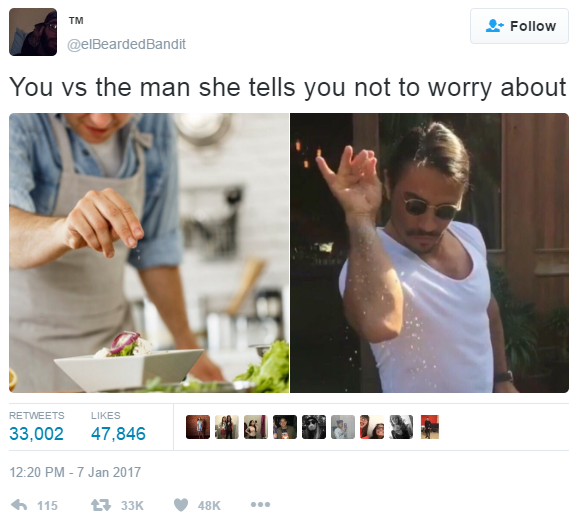
The First Meme
Memes began due to a misinterpretation of humor amongst colleagues in 1982. Issues would arise in this specific workplace because people thought their coworkers were being rude and aggressive online, but were actually trying to be funny. Scott E. Fahlman proposed to add a specific symbol (:)) to signify that the text was a joke. This symbol was called an emoticon. “Emoticons are a meme that serve a number of functions in the transmission of information. They can be used to frame content as positive or negative, serious or joking, or any number of other things”. (Michael Mandiberg) The use of these emoticons spread quickly and grew in meaning. Later, emoticons slowly transformed into captioning digital pictures which is known today as memes.
Types of Memes
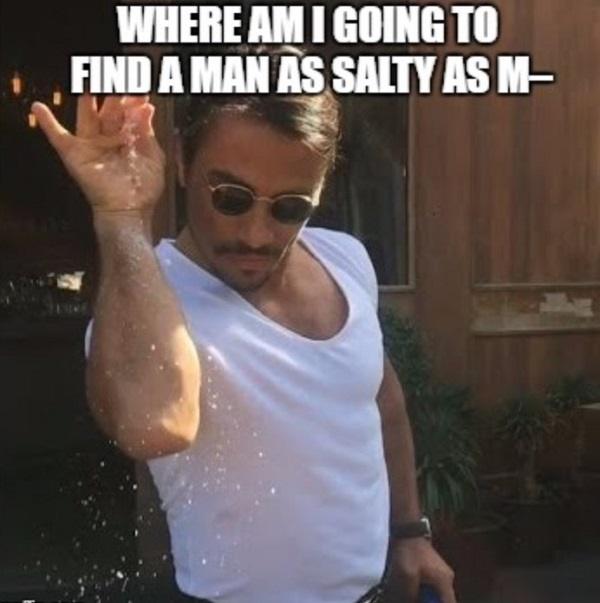
Memes can be interpreted in a variety of ways, but all memes exist in layers. “Internet memes follow the same structure. One very common, rather large meme is the image macro. An image macro is a set of stylistic rules for adding text to images.” (Michael Mandiberg) Image macros have two main forms. One type is adding the same text to different images, similar to the example above “You vs. The Guy She Told You Not To Worry About”. This is a common meme text that can be placed on a variety of different images. Another form of memes is where you add different text to the picture. An example of this is captioning the ‘salt bae’ meme “Where am I going to find a man as salty as me.” This is specific towards the image itself and wouldn’t necessarily make sense on other images. This meme has many layers because it uses both of these forms of image macros.
Culture of Memes
I was interested to explore memes place in culture and its cultural motivation. An article written by Mary Midgley explains that the word meme comes from ‘mimeme’, which means a unit of limitation. “Richard Dawkins has suggested that the scientific approach to culture is to split it into units called memes, which are in some ways parallel to its atoms, in others to its genes, and to study their interactions.” Mary Midglet explains that culture cannot be labeled and have distinct units because it is continuously developing and affected by human behavior. Mary Midglet was initially confused how culture was affected by memes since culture isn’t in units. Although, mimeme were transmitted and spread from person to person by copying each other. This relates to internet memes and specifically to the ‘salt bae’ meme. Once Nusret Gökçe posted his video of Instagram, it spread all over the world and generated media attention. Therefore, culture is affected by memes due to spreading and transmitting visuals and information from person to person.
Conclusion
Memes aim to bring humor and laughter into the world. Although, there are several critics who raise questions against memes and Limon Shifman elaborates on three reasons in his article. He claims that memes can be offensive and don’t successfully interpret human behavior, memes give no added value to soceity, and that memes can create issues between agencies. Even though the ‘salt bae’ memes don’t have educational added value to society, I believe it is not offensive and it does interpret human behavior in a unique way. This meme is a fun and eye-catching picture that makes people think and interpret the picture in their own way. I think memes are away to connect with one another and bring light humor in our daily lives. I appreciate all that memes have to offer and think they are a great contribution to society and help develop our culture.
Citations
Davison, Patrick. “The Language of Internet Memes.” Edited by Michael Mandiberg. Social Media Reader. http://fall2015.veryinteractive.net/content/6-library/20-the-language-of-internet-memes/davison-thelanguageofinternetmemes.pdf.
Midgley, Mary. “Why Memes?” Alas Poor Darwin: Arguments Against Evolutionary Psychology. https://books.google.es/books?hl=es&lr=&id=HQthCC191y8C&oi=fnd&pg=PT117&dq=cultural motivations for memes&ots=3dGBcCGoJB&sig=iPlkfHuoa0cT1lupGmfFMyua120#v=onepage&q&f=false
Shifman, Limor. “Memes in a Digital World: Reconciling with a Conceptual Troublemaker.” Computer-Mediated Communication, March 26, 2013. https://onlinelibrary.wiley.com/doi/full/10.1111/jcc4.12013.
Feinn, Lilly. “How Did Salt Bae Start? The Origins of This Meme Are Pretty Tasty.” Bustel. January 18, 2017. https://www.bustle.com/p/how-did-salt-bae-start-the-origins-of-this-meme-are-pretty-tasty-31231.

 Marli's Blog